FinsamudraNewsroom

Finsamudra Desk

SBI pulls $1.5 billion in FCNR deposits after RBI hedge subsidy

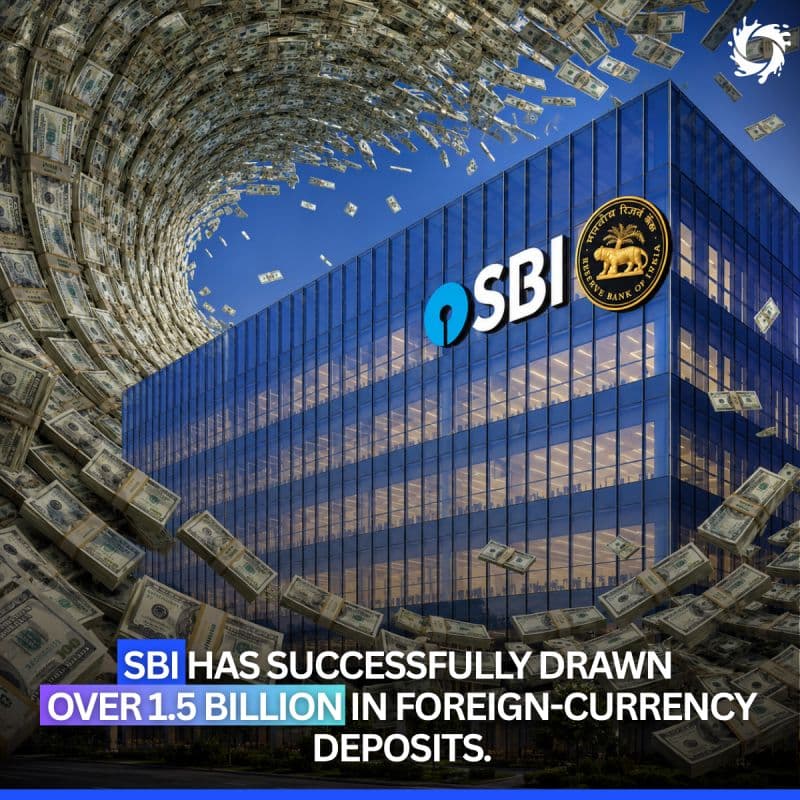
A hedging cost subsidy from the RBI let State Bank of India offer up to 7.5% dollar deposit rates backed by 9x leverage, drawing $1.5 billion in global capital.

$1.5 billionCapital raised via FCNR deposits
To understand how India's largest lender siphoned off $1.5 billion from the global market so quickly, look at the alignment between the Reserve Bank of India (RBI) and State Bank o
Image: Finsamudra LinkedIn archive
up to 7.5%Deposit interest rate offered
9xLeverage on the programme

State Bank of India has attracted $1.5 billion from the global market through FCNR (Foreign Currency Non-Resident) deposits, according to a LinkedIn analysis of the mechanics behind the inflow.

The trigger was an RBI policy introduced last month that subsidised hedging costs for banks collecting fresh FCNR deposits. SBI used this regulatory opening to design a leveraged deposit programme.

The bank offered non-resident depositors interest rates of up to 7.5% on US dollars, paired with 9x leverage. A depositor could put down a fraction of their own funds, borrow the rest at low global rates, and deposit the full sum at 7.5%, capturing the interest rate spread as low-risk profit.

By subsidising the hedge, the RBI enabled SBI to pull in global capital at scale, adding to India's forex reserves without putting pressure on domestic rupee liquidity.

Why it matters

For lenders and treasury teams, this is a live example of how a targeted regulatory subsidy (hedge cost support) can be converted into a large-scale deposit-gathering lever. It shows the direct link between RBI policy design and a bank's ability to mobilise offshore capital cheaply.

For DSAs and connectors working NRI or forex-linked products, the SBI structure signals that leveraged, rate-arbitrage deposit schemes are back in favour when policy support exists — a pattern worth tracking if similar hedge subsidies extend to other deposit categories or lenders.

More on the RBI

Every story on the RBI →

Sources

Join the conversation on LinkedIn →
Finsamudra DeskNewsroom · 10 Jul 2026, 1:30 pm IST

Refer loans to banks and NBFCs? Become a loan DSA partner

See all

Finsamudra Desk

The ₹8,415 Crore Reckoning: Inside Yes Bank’s Supreme Court Review Petition on AT-1 Bonds

On November 13, 2026, Yes Bank Limited disclosed to the stock exchanges that it had filed a review petition under Article 137 of the Constitution of India before the Supreme Court. The petition seeks a formal reconsideration of the apex court’s landmark judgment delivered on October 15, 2026, which quashed the write-down of ₹8,415 Crore in Additional Tier-1 (AT-1) perpetual bonds executed during the bank’s March 2020 reconstruction.

Economy3 min read

Finsamudra Desk

The 12% Yield Trap: Inside the Gadag Consumer Court’s ₹17.63 Lakh Order Against a Karnataka Credit Society—And What Retail Depositors Must Know

In a ruling underscoring both consumer redressal protections and the structural risks of high-yield non-bank deposits, the Gadag District Consumer Disputes Redressal Commission in Karnataka has ordered Kittur Rani Chennamma Urban Credit Souhardha Sahakari Ltd. to refund ₹17,63,274 in aggregated deposit principal, alongside overdue interest and legal damages, within eight weeks.

Economy3 min read

Get the Morning Brief

India's banking and finance news before your first call — subscribe free

The same daily intelligence 41,000+ CXOs, DSAs and finance professionals follow on LinkedIn, with the Finsamudra take.

The Morning Brief · Free

Get India's banking and finance news before your first call

The daily intelligence 41,000+ finance professionals follow on LinkedIn, in one short email from the Finsamudra Desk.