FinsamudraNewsroom

Finsamudra Desk

RBI cancels Shree Mahalaxmi Urban Co-op Bank licence; 97.9% depositors covered

The regulator ordered liquidation citing inadequate capital and no earning prospects, but DICGC insurance means nearly all depositors recover their money in full.

97.9%Depositors getting full money back
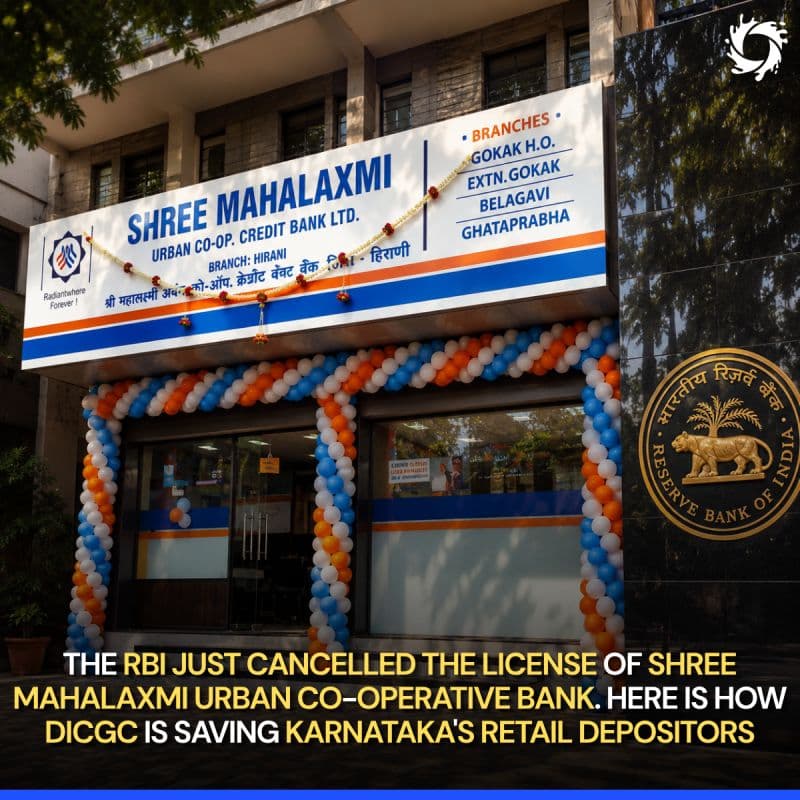
The Reserve Bank of India (RBI) just dropped the regulatory hammer on Shree Mahalaxmi Urban Co-operative Credit Bank. Effective immediately, their banking license is completely can
Image: Finsamudra LinkedIn archive
₹5 lakhDICGC deposit insurance limit

The Reserve Bank of India has cancelled the banking licence of Shree Mahalaxmi Urban Co-operative Credit Bank, effective immediately. A liquidator has been appointed to wind down the bank's operations.

RBI's stated rationale: the bank was running on inadequate capital, had zero viable earning prospects, and was operating in a manner that threatened the financial safety of its own depositors.

The key number from this failure is that 97.9% of depositors at the bank are set to recover all of their money. This is possible because of the Deposit Insurance and Credit Guarantee Corporation (DICGC), which insures every retail depositor up to ₹5 lakh.

For a small urban co-operative bank, the ₹5 lakh threshold is high enough to shield the vast majority of everyday customers from losses tied to management failures.

This action fits a broader pattern: RBI is conducting a systematic cleanup of weak, legacy co-operative banks nationwide, acting before problems can spread further into the financial system.

Why it matters

For DSAs and connectors sourcing deposits or referring customers to small urban co-operative banks, this is a reminder that regulatory risk in this segment is real and active — RBI is not hesitating to cancel licenses when capital adequacy and earnings viability fail. Any co-operative bank tie-ups should be assessed with this enforcement pattern in mind.

For lenders and depositors alike, the DICGC's ₹5 lakh cover is the mechanism that lets RBI act decisively without triggering broader panic or retail losses. Understanding this insurance ceiling matters for anyone advising clients on where to park deposits with smaller co-operative institutions.

More on the RBI

Every story on the RBI →

Sources

Join the conversation on LinkedIn →
Finsamudra DeskNewsroom · 19 Jun 2026, 5:36 pm IST

Refer loans to banks and NBFCs? Become a loan DSA partner

See all

Finsamudra Desk

The ₹8,415 Crore Reckoning: Inside Yes Bank’s Supreme Court Review Petition on AT-1 Bonds

On November 13, 2026, Yes Bank Limited disclosed to the stock exchanges that it had filed a review petition under Article 137 of the Constitution of India before the Supreme Court. The petition seeks a formal reconsideration of the apex court’s landmark judgment delivered on October 15, 2026, which quashed the write-down of ₹8,415 Crore in Additional Tier-1 (AT-1) perpetual bonds executed during the bank’s March 2020 reconstruction.

Economy3 min read

Finsamudra Desk

The 12% Yield Trap: Inside the Gadag Consumer Court’s ₹17.63 Lakh Order Against a Karnataka Credit Society—And What Retail Depositors Must Know

In a ruling underscoring both consumer redressal protections and the structural risks of high-yield non-bank deposits, the Gadag District Consumer Disputes Redressal Commission in Karnataka has ordered Kittur Rani Chennamma Urban Credit Souhardha Sahakari Ltd. to refund ₹17,63,274 in aggregated deposit principal, alongside overdue interest and legal damages, within eight weeks.

Economy3 min read

Get the Morning Brief

India's banking and finance news before your first call — subscribe free

The same daily intelligence 41,000+ CXOs, DSAs and finance professionals follow on LinkedIn, with the Finsamudra take.

The Morning Brief · Free

Get India's banking and finance news before your first call

The daily intelligence 41,000+ finance professionals follow on LinkedIn, in one short email from the Finsamudra Desk.