FinsamudraNewsroom

Finsamudra Desk

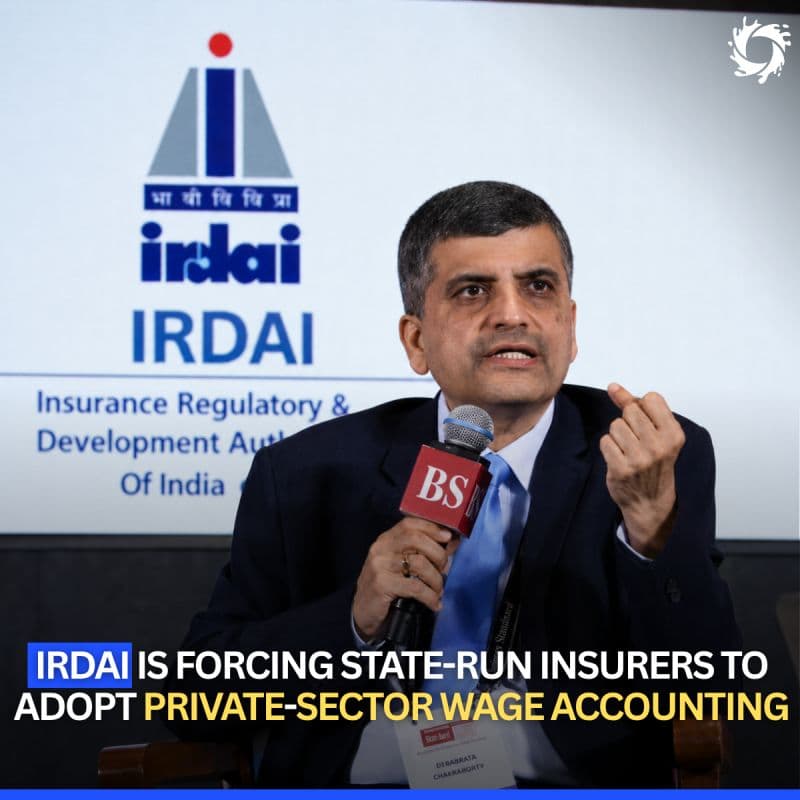
IRDAI mandates wage provision accounting for state insurers

Public sector general insurers must now set aside annual provisions for expected wage revisions instead of absorbing sudden lump-sum bills when deals are signed.

₹8,170 croreBackdated wage bill (2022–2026 deal)
State-run general insurers in India have operated under a massive accounting blind spot for decades. The Insurance Regulatory and Development Authority of India is finally shutting
Image: Finsamudra LinkedIn archive

State-run general insurers in India have long operated without accounting for future wage obligations annually. The Insurance Regulatory and Development Authority of India has now closed this gap by mandating that public sector general insurers calculate and create annual provisions for expected wage revisions.

The shift addresses a structural problem in how public sector wage negotiations work. Wage deals take years to negotiate and are typically backdated retrospectively upon approval. The recent wage hike approved in early 2026, for example, was backdated to 2022 and resulted in an ₹8,170 crore bill that hit insurer balance sheets all at once.

Previously, state-run insurers absorbed these entire back-pay bills as sudden, lump-sum shocks when deals were signed. The impact was severe: quarterly profits evaporated, solvency ratios collapsed, and insurers triggered emergency capital requirements that fell to taxpayers.

The government has signalled an end to this pattern. State-run insurers will receive no more taxpayer-funded capital infusions and must stand on their own feet. By forcing annual accounting for wage growth, the IRDAI is imposing private-sector balance sheet discipline on public-sector giants.

The change is simple in mechanics but significant in effect. By distributing wage liabilities across years rather than absorbing them as shocks, insurers can maintain stable solvency and avoid catastrophic profit impacts that threaten the Indian insurance safety net.

Why it matters

For DSAs, main DSAs, and lending partners, this matters because state-run general insurers are major sources of credit insurance and underwriting support in India's loan distribution chain. When their solvency ratios crater, credit products become more expensive or unavailable. Predictable insurer balance sheets mean steadier underwriting capacity and better product availability for loan distribution networks.

The mandate also signals a shift in how government views public-sector financial discipline. If state insurers must now provision for liabilities instead of relying on ad-hoc capital injections, this sets a precedent that applies downstream to all participants in India's credit ecosystem. Lenders and DSAs should expect regulators to demand the same rigor from any public-sector financial institution they depend on.

Sources

Join the conversation on LinkedIn →
Finsamudra DeskNewsroom · 12 Jul 2026, 9:00 am IST

Refer loans to banks and NBFCs? Become a loan DSA partner

See all

Finsamudra Desk

The ₹8,415 Crore Reckoning: Inside Yes Bank’s Supreme Court Review Petition on AT-1 Bonds

On November 13, 2026, Yes Bank Limited disclosed to the stock exchanges that it had filed a review petition under Article 137 of the Constitution of India before the Supreme Court. The petition seeks a formal reconsideration of the apex court’s landmark judgment delivered on October 15, 2026, which quashed the write-down of ₹8,415 Crore in Additional Tier-1 (AT-1) perpetual bonds executed during the bank’s March 2020 reconstruction.

Economy3 min read

Finsamudra Desk

The 12% Yield Trap: Inside the Gadag Consumer Court’s ₹17.63 Lakh Order Against a Karnataka Credit Society—And What Retail Depositors Must Know

In a ruling underscoring both consumer redressal protections and the structural risks of high-yield non-bank deposits, the Gadag District Consumer Disputes Redressal Commission in Karnataka has ordered Kittur Rani Chennamma Urban Credit Souhardha Sahakari Ltd. to refund ₹17,63,274 in aggregated deposit principal, alongside overdue interest and legal damages, within eight weeks.

Economy3 min read

Get the Morning Brief

India's banking and finance news before your first call — subscribe free

The same daily intelligence 41,000+ CXOs, DSAs and finance professionals follow on LinkedIn, with the Finsamudra take.

The Morning Brief · Free

Get India's banking and finance news before your first call

The daily intelligence 41,000+ finance professionals follow on LinkedIn, in one short email from the Finsamudra Desk.