FinsamudraNewsroom

Finsamudra Desk

RBI tightens rules on legacy loan provisions, pressures private bank earnings

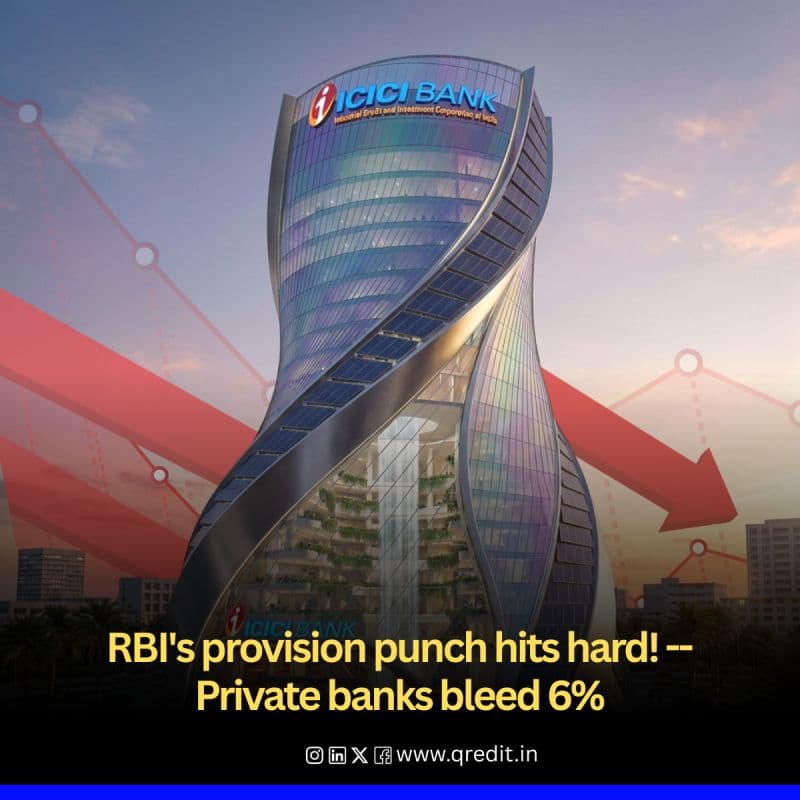
ICICI Bank and peers face heightened capital requirements for legacy credit issues, weighing on quarterly profits. Most loan portfolios remain sound despite the regulatory push.

Private bank stocks just took a hit after their latest earnings. 📉 RBI asked some, like ICICI Bank, to set aside extra money for old loan issues, dragging down profits.
Image: Finsamudra LinkedIn archive

Private bank stocks declined following latest quarterly earnings as the RBI imposed stricter provisioning norms on legacy loan issues. ICICI Bank was among lenders directed to set aside additional capital reserves, directly impacting reported profitability.

The regulatory move reflects RBI's focus on strengthening banks' buffers against older problem assets. Banks say most loans in their portfolios remain performing and solid, limiting near-term stress on asset quality.

Banks are already working through remediation of flagged exposures. The requirement to hold more reserves doesn't signal a deteriorating credit environment but rather ensures lenders maintain adequate cushions against historical risks.

For borrowers and account holders, immediate concerns are minimal. The banking system's core loan quality remains intact, and retail customers should face no operational disruptions from the provisioning adjustment.

Why it matters

For DSAs and loan connectors, this RBI directive matters because it signals tighter oversight of legacy credit on bank balance sheets. Banks facing higher provisioning costs may become more selective in deployment of new capital, potentially affecting dealer incentives and flow-through of low-cost products. Expect conversations around pricing and commission structures to shift as lenders manage return-on-equity pressure.

For lenders and NBFCs partnering with banks, the move underscores RBI's commitment to asset quality discipline. Connectors should monitor whether this prompts their partner banks to tighten sourcing standards or reduce allocations to riskier segments, which could reshape deal pipelines and borrower eligibility criteria in coming quarters.

More on the RBI

Every story on the RBI →

Sources

Join the conversation on LinkedIn →
Finsamudra DeskNewsroom · 19 Jan 2026, 5:01 pm IST

Refer loans to banks and NBFCs? Become a loan DSA partner

See all

Finsamudra Desk

The ₹8,415 Crore Reckoning: Inside Yes Bank’s Supreme Court Review Petition on AT-1 Bonds

On November 13, 2026, Yes Bank Limited disclosed to the stock exchanges that it had filed a review petition under Article 137 of the Constitution of India before the Supreme Court. The petition seeks a formal reconsideration of the apex court’s landmark judgment delivered on October 15, 2026, which quashed the write-down of ₹8,415 Crore in Additional Tier-1 (AT-1) perpetual bonds executed during the bank’s March 2020 reconstruction.

Economy3 min read

Finsamudra Desk

The 12% Yield Trap: Inside the Gadag Consumer Court’s ₹17.63 Lakh Order Against a Karnataka Credit Society—And What Retail Depositors Must Know

In a ruling underscoring both consumer redressal protections and the structural risks of high-yield non-bank deposits, the Gadag District Consumer Disputes Redressal Commission in Karnataka has ordered Kittur Rani Chennamma Urban Credit Souhardha Sahakari Ltd. to refund ₹17,63,274 in aggregated deposit principal, alongside overdue interest and legal damages, within eight weeks.

Economy3 min read

Get the Morning Brief

India's banking and finance news before your first call — subscribe free

The same daily intelligence 41,000+ CXOs, DSAs and finance professionals follow on LinkedIn, with the Finsamudra take.

The Morning Brief · Free

Get India's banking and finance news before your first call

The daily intelligence 41,000+ finance professionals follow on LinkedIn, in one short email from the Finsamudra Desk.