Finsamudra Newsroom, home

Finsamudra Desk

Government notifies Banking Laws (Amendment) Act, 2025 provisions effective August 1

Major changes to banking regulation take effect next month, raising thresholds for substantial interest and enabling public sector banks to align with corporate IEPF practices.

1968Last threshold revision
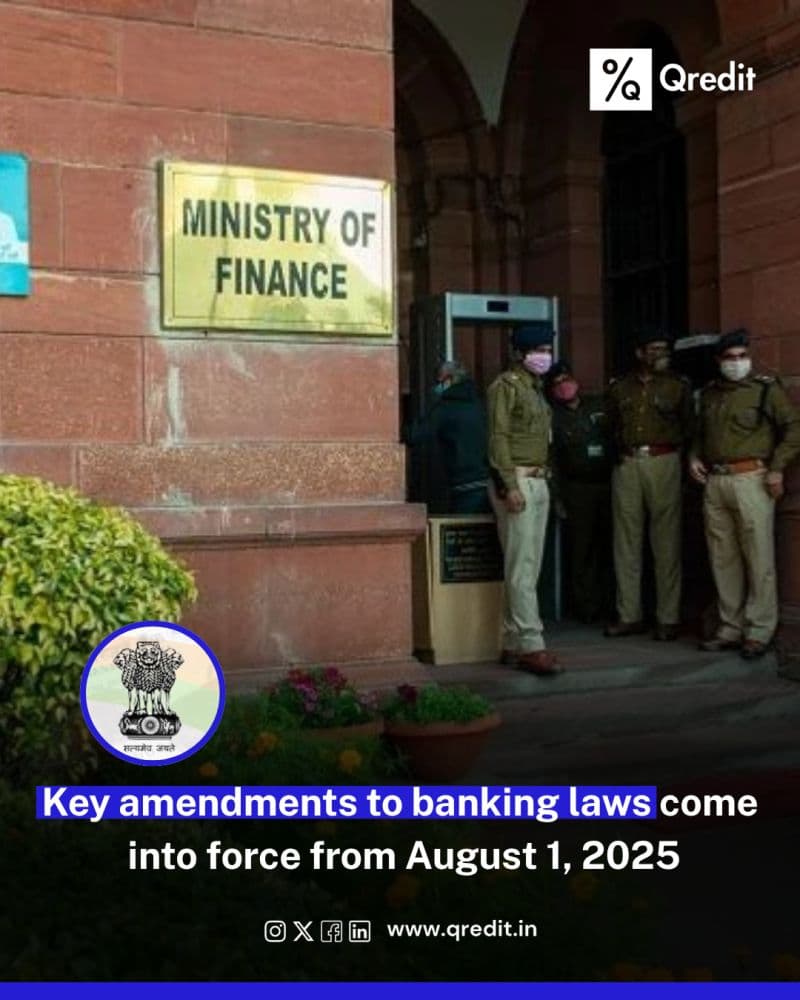
🚨 Major Banking Law Changes Coming from August 1, 2025!
Image: Finsamudra LinkedIn archive
₹5 lakh → ₹2 croreSubstantial interest threshold update
8 years → 10 yearsCooperative bank director tenure

The Government of India has officially notified key provisions of the Banking Laws (Amendment) Act, 2025—enacted in April—will become effective from August 1, 2025. The changes span amendments to the Banking Regulation Act, 1949, and the SBI Act and Banking Companies Acts of 1970 and 1980, touching governance, investor protection, and audit standards across the banking sector.

Sections 3, 4, and 5 raise the threshold for 'substantial interest' from ₹5 lakh to ₹2 crore, marking the first update to this measure since 1968. The amendments also extend maximum director tenure in cooperative banks from 8 to 10 years, aligning with the 97th Constitutional Amendment and clarifying governance definitions for cooperative institutions.

Under Sections 15–20, public sector banks (PSBs) gain the power to transfer unclaimed dividends, interest, and bond redemption proceeds to the Investor Education and Protection Fund (IEPF), bringing banking law in line with corporate practices under the Companies Act, 2013. This move standardizes investor protection mechanisms across the financial sector.

A significant operational change allows PSBs to remunerate statutory auditors directly—a shift aimed at enhancing audit quality and strengthening financial oversight. Previously, such compensation was constrained, potentially limiting audit depth and effectiveness.

Why it matters

For DSAs, loan agents, and credit distributors, these changes modernize the regulatory foundation on which lending relationships rest. The updated substantial interest threshold affects control and disclosure rules; the IEPF alignment ensures customer funds—including dividends and interest—are protected and recoverable through a standardized mechanism, reducing friction in dispute resolution and borrower confidence.

Stronger audit standards and clearer governance norms for cooperative banks directly improve lender reliability. As DSAs and connectors work with a broader range of banking partners, these harmonized rules reduce compliance friction, lower operational risk, and make it easier to integrate cooperative banks into loan distribution networks. Better audit oversight also signals sounder credit intermediation.

Sources

Join the conversation on LinkedIn →
Finsamudra DeskNewsroom · 31 Jul 2025, 3:35 pm IST
See all

Get the Morning Brief

India's lending news before your first call — subscribe free

The same daily intelligence 30,000+ CXOs, DSAs and finance professionals follow on LinkedIn, with the Finsamudra take.

The Morning Brief · Free

Get India's lending news before your first call

The daily intelligence 30,000+ finance professionals follow on LinkedIn, in one short email from the Finsamudra Desk.