Finsamudra Newsroom, home

Finsamudra Desk

IRDAI approves two general insurance licenses under new 100% FDI policy

India's insurance regulator has greenlit two new entrants following a landmark shift to allow full foreign ownership. Global insurers can now build standalone Indian operations without local joint-venture partners.

100%FDI cap in general insurance
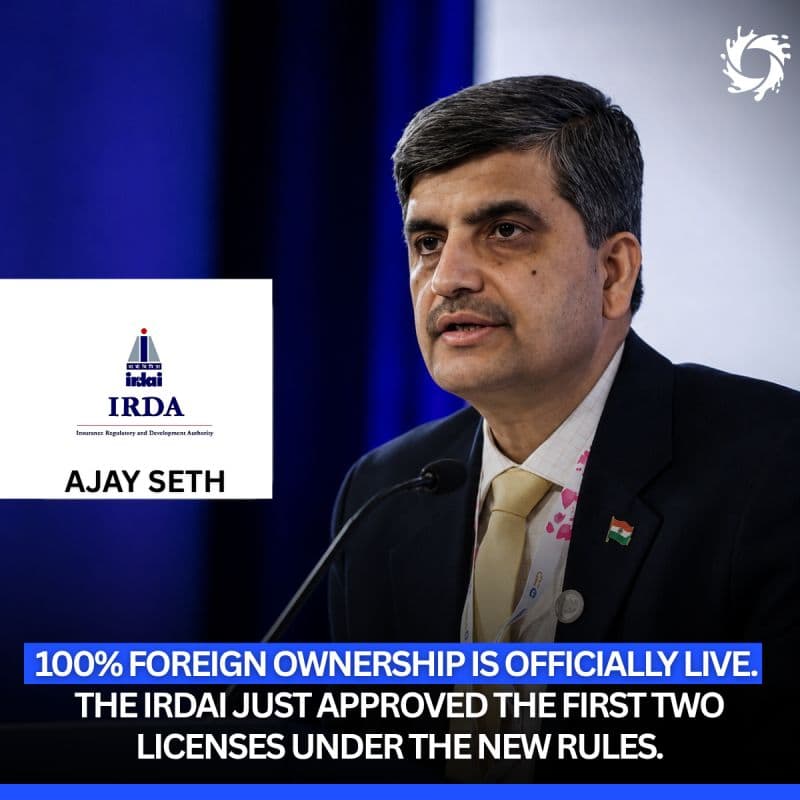
Insurance Regulatory and Development Authority of India Chairperson
Image: Finsamudra LinkedIn archive

IRDAI Chairperson Ajay Seth has confirmed approval of two new general insurance licenses, marking the first major licensing wave under India's freshly liberalised foreign direct investment rules. Until now, foreign insurers entering India were forced into joint ventures with local conglomerates, capped at minority stakes and obliged to share control of brand, distribution, and proprietary underwriting technology.

The 100% FDI policy removes these constraints entirely. Global insurance giants can now establish wholly-owned Indian subsidiaries, retain full control of underwriting systems, and deploy their global balance sheets to absorb early-stage losses while scaling operations. Profit-sharing with local partners is no longer mandatory.

This structural shift fundamentally changes competitive dynamics in Indian insurance. For decades, domestic players leveraged sprawling agent networks and brand recognition built over generations. That advantage erodes when global competitors can apply sophisticated algorithms, massive capital pools, and international expertise without compromise or dilution.

The timing is critical. The government's upcoming Bima Sugam platform—positioned as insurance's equivalent to UPI—will dramatically reduce friction in policy purchase and comparison. A frictionless marketplace combined with well-capitalised foreign entrants creates a new operating environment for legacy Indian insurers.

Foreign capital is now officially repositioning for India's insurance sector. The question facing domestic players is whether this influx will finally crack India's chronic under-insurance problem or simply concentrate market share among global players with superior technology and lower cost of capital.

Why it matters

For DSAs and loan connectors in India's credit distribution space, this development has indirect but real implications. Insurance is tightly bundled with lending—credit-linked policies, loan protection cover, and cross-sell opportunities form a material part of the connector revenue stack. When foreign insurers enter with lower underwriting costs and faster claims automation, the unit economics of bundled offerings shift, and smaller domestic insurers may cut commissions or exit segments entirely.

Lenders and NBFCs relying on insurance partnerships for risk mitigation and regulatory compliance should monitor product availability and pricing. Global insurers may aggressively price early-stage products to capture market share, which could improve loan economics short-term but create longer-term dependency on foreign partners' strategic choices. For connectors, this is a signal to diversify insurance partnerships and negotiate lock-in periods carefully.

Sources

Join the conversation on LinkedIn →
Finsamudra DeskNewsroom · 5 Jul 2026, 12:45 pm IST
See all

Get the Morning Brief

India's lending news before your first call — subscribe free

The same daily intelligence 30,000+ CXOs, DSAs and finance professionals follow on LinkedIn, with the Finsamudra take.

The Morning Brief · Free

Get India's lending news before your first call

The daily intelligence 30,000+ finance professionals follow on LinkedIn, in one short email from the Finsamudra Desk.