FinsamudraNewsroom

Finsamudra Desk

The ₹28,000 Crore Laundering Network: Why Account-Unfreezing is Banking’s Blind Spot

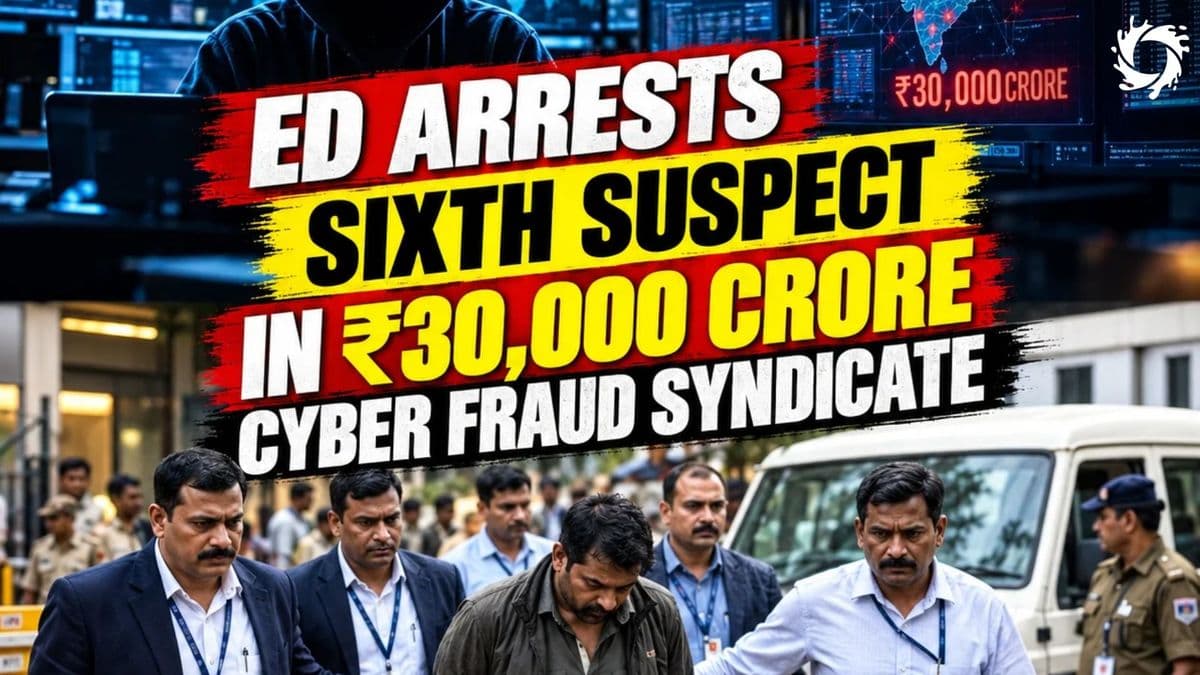
The interception of Mumbai advocate Rashesh Upadhyay (alias Rashesh Shah) at Mumbai Airport by the Enforcement Directorate (ED) marks a critical breakthrough in dismantling India’s most sophisticated cyber fraud apparatus.

Hero Image
Image: -Finsamudra

Originating from a single ₹2.60 crore "digital arrest" extortion complaint registered by the Goa Police Cyber Cell, the investigation has uncovered a staggering ₹28,000 crore in cumulative banking transactions, including roughly ₹2,900 crore deposited as physical cash across hundreds of layered accounts.

The Architecture of the Mule Economy

Modern cybercrime syndicates have evolved beyond crude wire scams into an institutional shadow economy. Victims targeted by "digital arrest" schemes—coerced by criminals falsely claiming association with the CBI, ED, or state police—are instructed to transfer funds into corporate current accounts belonging to shell companies.

Within minutes, automated transaction scripts disperse these deposits across a sprawling web of retail mule accounts held across tier-2 and tier-3 banks, creating a multi-tiered transaction maze that frustrates traditional AML monitoring.

The Unfreezing Blind Spot: The Real Vulnerability

The ED's most alarming discovery is not the volume of stolen capital, but the systematic compromise of post-freeze enforcement.

When state cyber cells detect fraud and initiate automated lien freezes through the Indian Cybercrime Coordination Centre (I4C), criminal syndicates encounter trapped liquidity. According to investigators, Upadhyay operated as the network's dedicated fixer. Despite holding legal qualifications, he never filed formal court appearances (Vakalatnamas). Instead, he allegedly orchestrated cash payoffs routed through informal courier (angadiya) networks to corruptly secure unauthorized "unfreeze" instructions, allowing the syndicate to drain sequestered funds.

Why it matters

Strategic Takeaway for BFSI Risk Leaders

For commercial banks and payment intermediaries, this case underscores an existential compliance gap: Transaction monitoring is useless if account-unfreezing remains an open operational loop.

Financial institutions must immediately implement zero-trust protocols for unfreezing accounts: requiring end-to-end cryptographic signatures and direct API validation with designated cyber police nodes before any administrative freeze is lifted. In the fight against industrial-scale cyber laundering, operational loopholes at the branch level represent the weakest link.

Sources

Finsamudra Desk26 Oct 2026, 5:06 pm IST

Refer loans to banks and NBFCs? Become a loan DSA partner

See all

Finsamudra Desk

Supervisory Continuity in Co-operative Banking: Inside the RBI’s One-Year Extension for Abhyudaya Co-operative Bank’s Administrator

On November 9, 2026, via Press Release 2026-2027/1473, the Reserve Bank of India (RBI) exercised its statutory powers under sub-section (1) of Section 36AAA read with Section 56 of the Banking Regulation Act, 1949, extending the supersession of the Board of Directors of Abhyudaya Co-operative Bank Ltd., Mumbai for a further period of one year effective November 24, 2026.

Business3 min read

Finsamudra Desk

The Sovereign Cross-Border Gateway: Inside Razorpay’s Final IFSCA Licence in GIFT City

India’s cross-border financial plumbing has reached a decisive turning point. Razorpay Software Private Limited, one of India's preeminent financial technology giants, has officially received its final Payment Service Provider (PSP) licence from the International Financial Services Centres Authority (IFSCA) to operate full-stack cross-border money movement out of GIFT City, Gujarat.

Business3 min read

Finsamudra Desk

Anatomy of an Insider Siphon: How ₹35 Crore Vanished Silently from PNB Greater Noida

A major operational and internal control failure has emerged at Punjab National Bank’s (PNB) Aichhar branch near Sector Pi-1 in Greater Noida, Uttar Pradesh. Dozens of depositors—primarily farmers who had deposited government compensation payouts for land acquisition—discovered that nearly ₹35 crore had been siphoned off from their savings accounts and fixed deposits without their consent.

Business3 min read

Get the Morning Brief

India's banking and finance news before your first call — subscribe free

The same daily intelligence 41,000+ CXOs, DSAs and finance professionals follow on LinkedIn, with the Finsamudra take.

The Morning Brief · Free

Get India's banking and finance news before your first call

The daily intelligence 41,000+ finance professionals follow on LinkedIn, in one short email from the Finsamudra Desk.