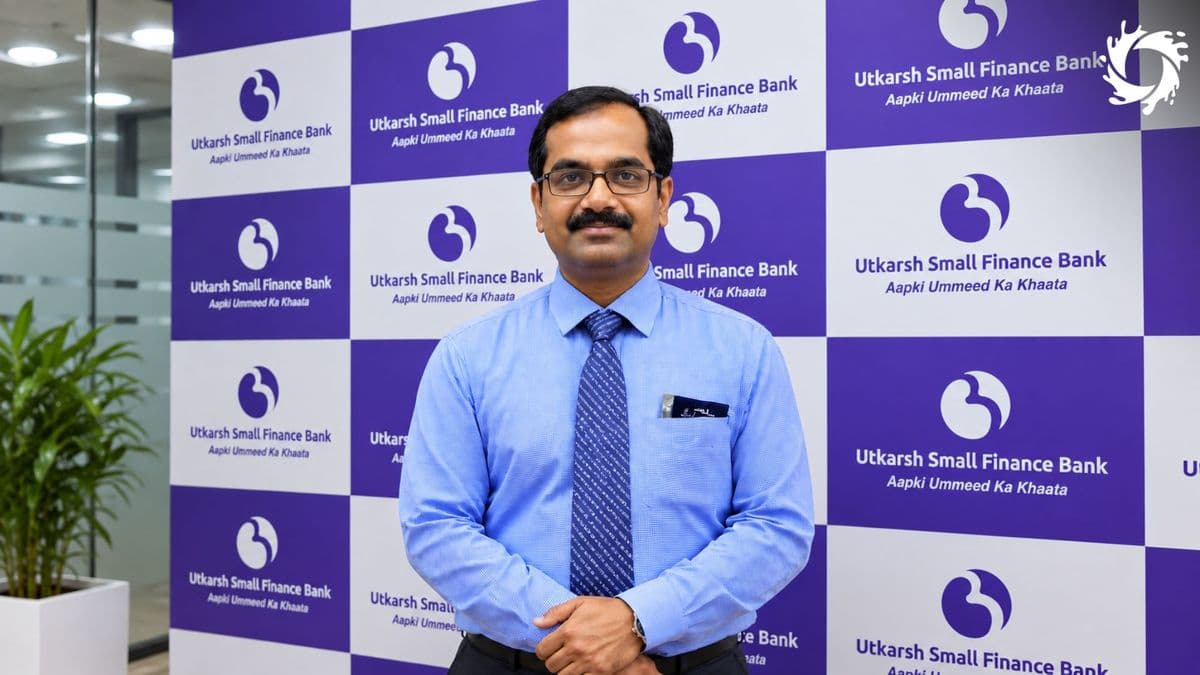
Ahead of its pivotal board meeting on September 19, 2026, the bank announced a defining leadership transition: Manmohan Shetty, a seasoned financial executive with nearly a decade at British multinational giant Barclays and ten years steering finance at institutional NBFC Viksit Capital (IREP Credit), is slated to take over as Chief Financial Officer. He succeeds Sarju Simaria, who is being elevated to the Board of Directors as a Whole-time Director (WTD).
While executive appointments in banking are frequent, Shetty’s arrival in Varanasi carries profound symbolic and structural weight: it marks the definitive graduation of India’s small finance banking sector from high-touch rural micro-lenders into institutionalized, treasury-driven commercial banks.
Section 1: The Anatomy of a CFO Upgrade
To understand why this appointment matters, one must examine the specific pedigree Manmohan Shetty brings to Utkarsh SFB’s balance sheet.
Why Multinational Pedigree Matters for an SFB
In the formative years of a Small Finance Bank, the chief financial officer’s mandate revolves around regulatory compliance, book-keeping, and coordinating with statutory auditors. However, once an SFB crosses the ₹20,000-crore asset threshold and lists on public bourses, the operational battlefield changes completely:
- Treasury Optimization as a Profit Center: In an environment where the Reserve Bank of India has tightened deposit competition and revised Liquidity Coverage Ratio (LCR) guidelines, a bank cannot rely solely on high deposit interest rates. The CFO must squeeze 25 to 50 basis points of alpha from the investment portfolio, sovereign yield-curve movements, and money-market repo operations.
- Asset-Liability Duration Matching (ALM): Small Finance Banks lend long (especially as they expand into 15-year affordable housing and 5-year MSME loans) while borrowing short (1-to-2-year retail fixed deposits). Managing this structural duration mismatch requires institutional sophistication to prevent liquidity crunches during rate cycles.
- Wholesale Liability Diversification: Beyond retail deposits, an expanding SFB requires institutional refinancing lines, Tier-2 subordinated debt issuances, pass-through securitization transactions, and external commercial borrowings (ECBs). Shetty’s extensive network with domestic mutual funds, foreign banks, and credit rating agencies provides Utkarsh with direct access to sophisticated wholesale debt markets.
Section 2: Outgrowing the Microfinance Monoculture
The strategic backdrop to this leadership reshuffle is the broader structural pivot underway across India’s Small Finance Bank landscape.
Most SFBs—including Utkarsh, Equitas, Ujjivan, and Jana—originated as Non-Banking Financial Company-Microfinance Institutions (NBFC-MFIs). While the microfinance engine generated enviable Net Interest Margins (NIMs) north of 8% to 10%, it also exposed lenders to periodic systemic shocks: monsoon failures, regional political loan waivers, overleveraging of unhedged rural borrowers, and seasonal heatwaves.
The Post-IPO Mandate
Following its blockbuster listing in July 2023, Utkarsh SFB committed to systematically diversifying its asset book away from unsecured microfinance toward secured retail lending:
- Micro-Banking: Retaining its core profitable franchise in joint-liability lending while implementing stricter leverage caps.
- Affordable Housing Loans: Expanding long-tenure, mortgage-backed lending to self-employed informal borrowers.
- MSME & Secured Business Credit: Financing established semi-urban manufacturing and trading enterprises.
- Commercial Vehicle & Construction Equipment: Capturing transport financing in developing economic corridors.
Elevating Sarju Simaria to Whole-time Director allows the bank to retain institutional continuity and strategic oversight at the Board level, while freeing the CFO desk for a dedicated, capital-markets-oriented operator in Manmohan Shetty to optimize the balance sheet for this diversified asset portfolio.
Section 3: The Regulatory Endgame – The Road to a Universal Bank
Behind every major executive appointment at a Tier-1 Small Finance Bank sits an unspoken institutional ambition: securing a Universal Banking License from the Reserve Bank of India.
In April 2024, the Reserve Bank released its formal framework outlining the eligibility criteria for Small Finance Banks aspiring to transition to regular Universal Banks:
Why Institutional Governance Is the True Prerequisite
While quantitative financial metrics (CRAR, Net NPA, Net Worth) can be tracked on a balance sheet, the Reserve Bank’s ultimate qualitative test during a universal bank evaluation is management bench strength and governance maturity.
The central bank scrutinizes whether an institution still operates like an entrepreneur-led micro-lender or whether it has built independent, institutionalized risk, compliance, and financial control architectures capable of handling complex commercial transactions, derivative products, and foreign exchange desks.
By hiring a veteran with nine years at Barclays, Utkarsh SFB is proactively aligning its leadership profile with the central bank’s expectations, signaling that its financial reporting and governance standards match the requirements of India's universal banking club.
Section 4: Strategic Lessons for Emerging Financial Institutions
The leadership evolution at Utkarsh SFB provides three foundational takeaways for founders, directors, and private equity sponsors across the Indian financial services landscape:
1. Transition from "Founder-Driven" to "Process-Driven" Finance
In early-stage lending, speed and relationship-based underwriting drive growth. At scale, shareholder value is preserved by institutional controllership. Bringing in multinational banking veterans ensures that financial reporting, provisioning matrices, and risk models are institutionalized beyond individual personalities.
2. The Boardroom Elevation Strategy
When an internal leader has successfully steered an institution through a critical milestone (such as Sarju Simaria guiding Utkarsh through its public listing), promoting them to a Whole-time Directorship preserves institutional memory while opening senior executive chairs for specialized market talent.
3. Proactive ALM and Treasury Hardening
In an era of volatile interest rate cycles and digital deposit runs, a lending institution cannot treat treasury management as a back-office support function. The CFO must operate as an active strategic architect, continually matching duration profiles and lowering blended funding costs.