Finsamudra Newsroom, home

Finsamudra Desk

Oxyzo scales ₹10,500 Cr loan book while holding NPA at 0.74%

Oxyzo Financial Services grew assets 28% year-on-year in FY26 while maintaining tight credit discipline. The fintech's ecosystem lending model delivers precision in SME risk management.

0.74%Gross NPA
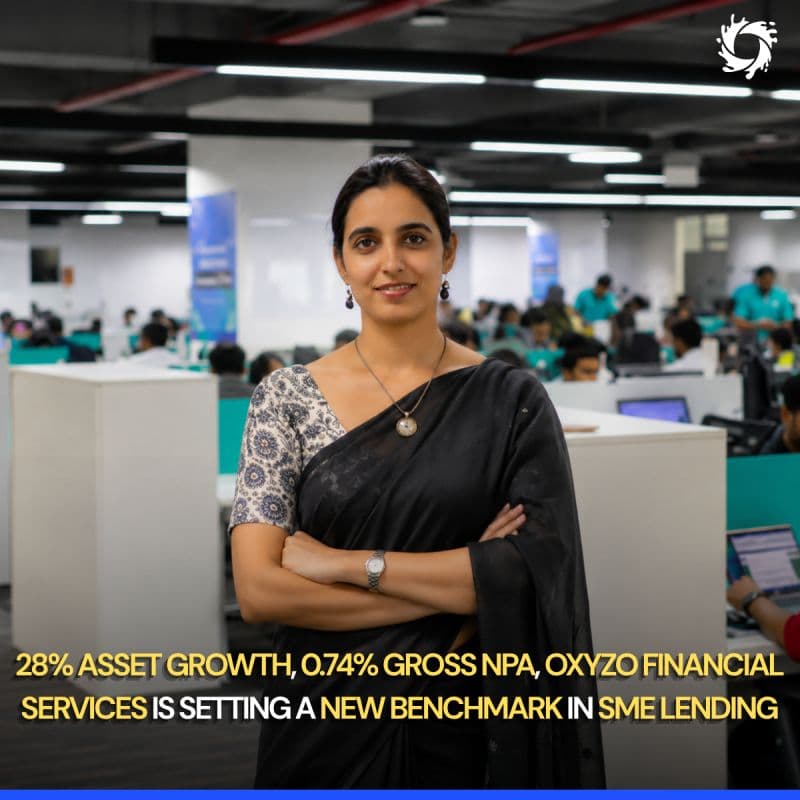
🧿If you look at the FY26 results released by Oxyzo Financial Services (the financial arm of OfBusiness), the revenue numbers are impressive. But that isn't the real story here.
Image: Finsamudra LinkedIn archive
₹10,500 Cr (28% YoY)Loan book growth
23% to ₹1,488.8 CrOperating revenue growth

Oxyzo Financial Services, the lending arm of B2B commerce platform OfBusiness, released FY26 results that reveal a tension most fintech lenders struggle to resolve: rapid growth without rising defaults. The company pushed its loan book past ₹10,500 Crore—a 28% year-on-year expansion—while holding Gross NPA at just 0.74% and Net NPA at 0.30%.

In SME lending, speed of growth typically correlates with credit risk. Aggressive scaling usually means weaker underwriting, rising defaults, and rising provisioning costs. Oxyzo's metrics suggest a different playbook. Operating revenue jumped 23% to ₹1,488.8 Crore; net profit rose 11% to ₹375.5 Crore. These gains came without sacrificing asset quality.

The difference lies in data. OfBusiness, a B2B supply chain platform, holds real-time visibility into its borrowers' transaction histories, cash flows, and buyer networks. When Oxyzo lends to merchants on that ecosystem, it is not lending blind. Each loan decision rests on documented commercial behavior, not bureaus or collateral proxies alone.

This ecosystem model challenges the traditional NBFC playbook. Fintech lenders without supply chain integration must rely on harder collateral, thicker documentation, or accept higher default rates. Oxyzo demonstrates that embedded lending—built into a commerce network—can compress both fraud risk and operational overhead at scale.

Why it matters

For DSAs and loan agents, Oxyzo's results raise a structural question: does the standalone agent or distributor model remain competitive against ecosystem lenders? Margins in loan distribution are tightening as banks move direct-to-consumer. Agents backed by platforms with transaction data and cash flow visibility will undercut competitors on speed, approval rates, and pricing. Connectors may need to pivot toward platforms that offer data-enrichment or risk analytics—not just leads.

For NBFCs and banks, the message is plain: B2B ecosystem lending works because it replaces guesswork with evidence. Lenders who can integrate with borrower transaction networks—invoicing systems, payment gateways, supplier networks—will lower default costs and unlock higher volumes. Standalone lenders face pressure to either partner with platforms or accept lower ROA and slower growth.

Sources

Join the conversation on LinkedIn →
Finsamudra DeskNewsroom · 3 Jun 2026, 2:30 pm IST
See all

Finsamudra Desk

Scaling Beyond ₹1,500 Crore: Why Amit Saini’s Appointment Anchors Namdev Finvest’s Risk Moat

The appointment of Amit Saini as Head of Risk Management at Namdev Finvest Limited marks a vital governance consolidation for the Jaipur-headquartered non-banking financial company (NBFC). Saini brings extensive experience across risk governance, internal audit, and credit controls, having previously served as Chief Risk Officer at Choice, with formative tenures at Laxmi India Finance and benchmark affordable housing lender Aavas Financiers Ltd.

Startups1 min read

Get the Morning Brief

India's lending news before your first call — subscribe free

The same daily intelligence 30,000+ CXOs, DSAs and finance professionals follow on LinkedIn, with the Finsamudra take.

The Morning Brief · Free

Get India's lending news before your first call

The daily intelligence 30,000+ finance professionals follow on LinkedIn, in one short email from the Finsamudra Desk.