Finsamudra Newsroom, home

Finsamudra Desk

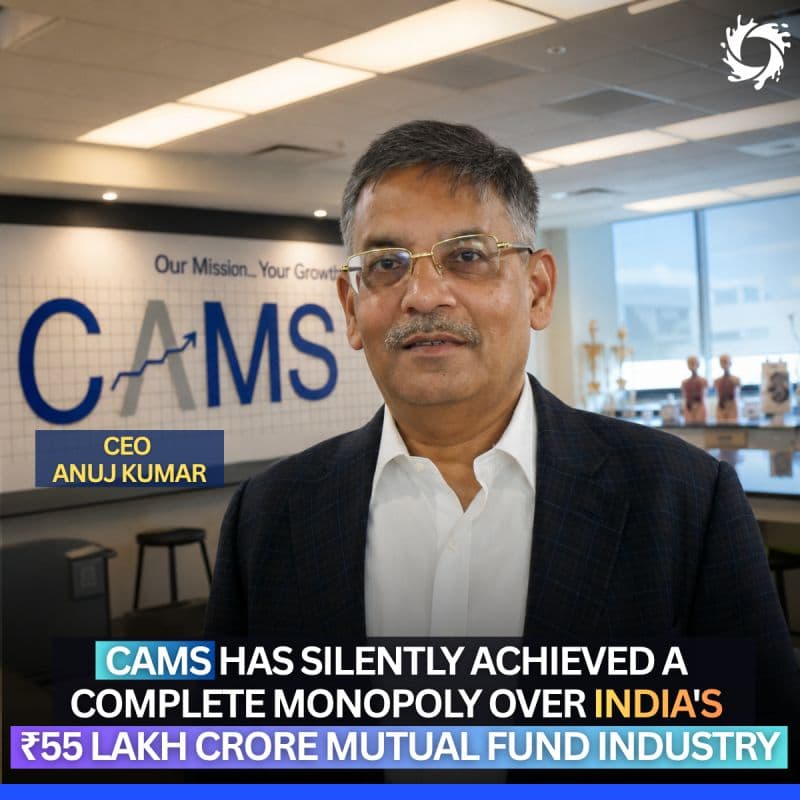
CAMS controls 68% of India's mutual fund market, invisible but irreplaceable

Founded in 1988, Computer Age Management Services processes nearly every SIP in the country without consumer marketing or a branded app—a masterclass in back-end dominance.

68%Mutual fund market share
Groww, Zerodha and Angel One are fighting a brutal, multi-million-dollar war for your attention. But a Chennai-based company founded in 1988 has already won.
Image: Finsamudra LinkedIn archive
₹55 lakh croreAssets processed
1988Year founded

CAMS Limited, a Chennai-based company founded in 1988, operates India's mutual fund infrastructure with minimal public recognition. The company processes investor records and fund transactions for the entire industry, making it the backbone of a market that spans nearly ₹55 lakh crore in assets.

While fintech apps like Groww, Zerodha, and Angel One fight for consumer attention with slick interfaces and marketing spend, CAMS collects transaction fees on almost every SIP—without owning a single mutual fund, running consumer ads, or maintaining a consumer-facing application.

The company's market position rests on operational inertia. Moving decades of investor records and registry systems to a competitor is so complex that fund houses almost never attempt it. This switching cost is CAMS's moat.

Front-end visibility attracts capital and user growth metrics. Back-end infrastructure attracts recurring revenue and defensibility. CAMS built neither consumer hype nor consumer apps, yet became completely irreplaceable to the mutual fund industry.

The distinction matters for founders: noisy, expensive front-end competition versus quiet, durable back-end dominance. CAMS chose the latter and became invisible to retail investors while controlling two-thirds of the mutual fund market.

Why it matters

For DSAs, loan agents, and fintech connectors, CAMS's story illustrates a critical lesson: the most valuable businesses in financial services are often the ones users never see. Distribution networks, settlement infrastructure, and registry systems generate steady, high-margin revenue with minimal customer acquisition cost. As lending distribution networks mature in India, the connectors and processors who own the back-end rails—not the consumer-facing apps—will capture the most durable economics.

CAMS also reveals why banks and NBFCs lock in technology partners. Once a lender adopts a loan distribution or documentation system, switching costs become prohibitive. Builders focused on becoming indispensable infrastructure (rather than competing on consumer features) create defensible, recession-resistant businesses that regulators cannot easily disrupt.

Sources

Join the conversation on LinkedIn →
Finsamudra DeskNewsroom · 7 Jul 2026, 9:00 am IST
See all

Finsamudra Desk

Scaling Beyond ₹1,500 Crore: Why Amit Saini’s Appointment Anchors Namdev Finvest’s Risk Moat

The appointment of Amit Saini as Head of Risk Management at Namdev Finvest Limited marks a vital governance consolidation for the Jaipur-headquartered non-banking financial company (NBFC). Saini brings extensive experience across risk governance, internal audit, and credit controls, having previously served as Chief Risk Officer at Choice, with formative tenures at Laxmi India Finance and benchmark affordable housing lender Aavas Financiers Ltd.

Startups1 min read

Get the Morning Brief

India's lending news before your first call — subscribe free

The same daily intelligence 30,000+ CXOs, DSAs and finance professionals follow on LinkedIn, with the Finsamudra take.

The Morning Brief · Free

Get India's lending news before your first call

The daily intelligence 30,000+ finance professionals follow on LinkedIn, in one short email from the Finsamudra Desk.