Finsamudra Newsroom, home

Finsamudra Desk

Bajaj Finance built ₹5.47 lakh crore AUM by ignoring its legacy playbook

When Bajaj Finance inherited a struggling two-wheeler captive finance arm in 2007, leadership bet against its core asset and pivoted to point-of-sale consumer durables—a market banks had written off.

₹2,500 CrLoan book at demerger (2007)
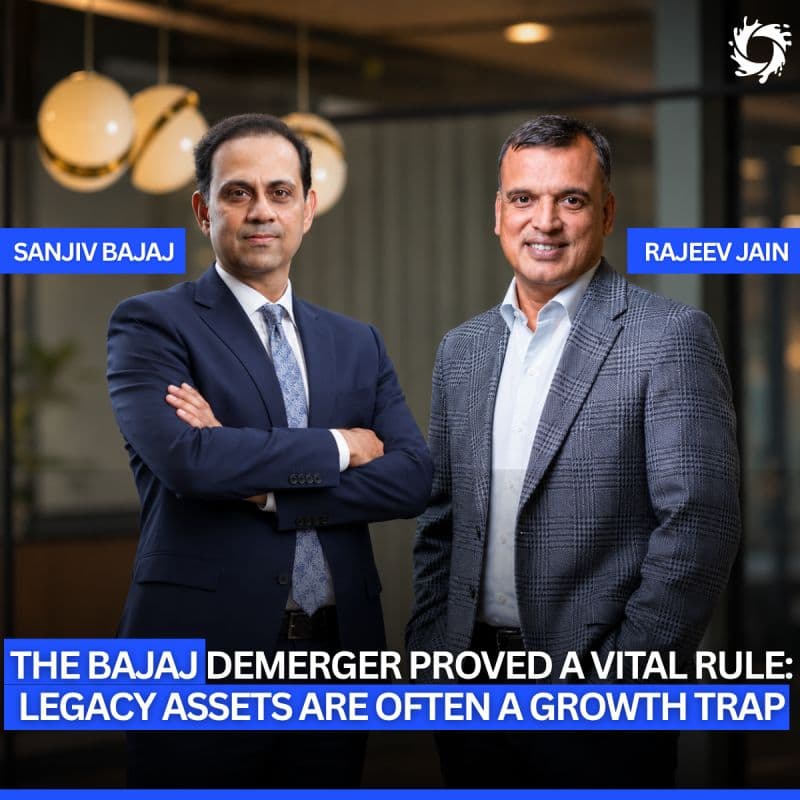
When the @Bajaj empire demerged in 2007, everyone assumed Rajiv Bajaj walked away with the crown jewel: the legacy automotive business.
Image: Finsamudra LinkedIn archive
₹5.47 lakh CrConsolidated AUM today
124 million+Customer franchise

The 2007 Bajaj demerger left Sanjiv Bajaj with what appeared to be a liability: a captive financier with a ₹2,500 crore loan book, 85% locked into two-wheeler financing, and a gross NPA ratio approaching 10%. Management depth was minimal, and the business model was tethered entirely to supporting Bajaj Auto Ltd's sales.

Rather than defend this inherited perimeter, Bajaj Finance's leadership—Sanjiv Bajaj and newly hired professional CEO Rajeev Jain—made a counterintuitive move. They abandoned vehicle financing to chase a market India's traditional banks had dismissed: point-of-sale consumer durable loans, particularly no-cost EMI products.

That single bet rewired the company's trajectory. Banks had deemed the segment too fragmented, too high-volume, and too expensive to service profitably. Bajaj Finance saw the opposite: structural whitespace.

The numbers vindicate the pivot. Consolidated AUM now stands at ₹5.47 lakh crore, serving a customer franchise of over 124 million. Bajaj Finance is now India's largest non-banking financial powerhouse and its most profitable consumer lending business.

The demerger's real lesson transcends the Bajaj family narrative. It illustrates a leadership paradox: organizations constrained by legacy asset protection often lose the freedom to build at scale. Sanjiv Bajaj inherited a blank slate—not because the asset was weak, but because it wasn't core to the demerged entity's identity.

Why it matters

For DSAs, connectors, and lenders in India's credit distribution network, Bajaj Finance's evolution demonstrates how distribution advantage trumps product legacy. A business initially dependent on a single OEM channel became a mass-market platform precisely because it wasn't anchored to defending existing relationships. Modern lenders and DSAs building franchise value should ask: what constraints are inherited, and which are worth breaking?

The consumer durables lending segment Bajaj Finance cracked remains high-volume, low-margin, and operationally demanding—but it generates profitable scale that vehicle financing never could. For sub-DSAs and loan distribution platforms, the lesson is concrete: market segments banks reject as 'too expensive to serve' often hide the highest unit economics when approached with distribution technology rather than legacy branch infrastructure.

More on Bajaj

Every story on Bajaj →

Sources

Join the conversation on LinkedIn →
Finsamudra DeskNewsroom · 9 Jul 2026, 12:45 pm IST
See all

Get the Morning Brief

India's lending news before your first call — subscribe free

The same daily intelligence 30,000+ CXOs, DSAs and finance professionals follow on LinkedIn, with the Finsamudra take.

The Morning Brief · Free

Get India's lending news before your first call

The daily intelligence 30,000+ finance professionals follow on LinkedIn, in one short email from the Finsamudra Desk.