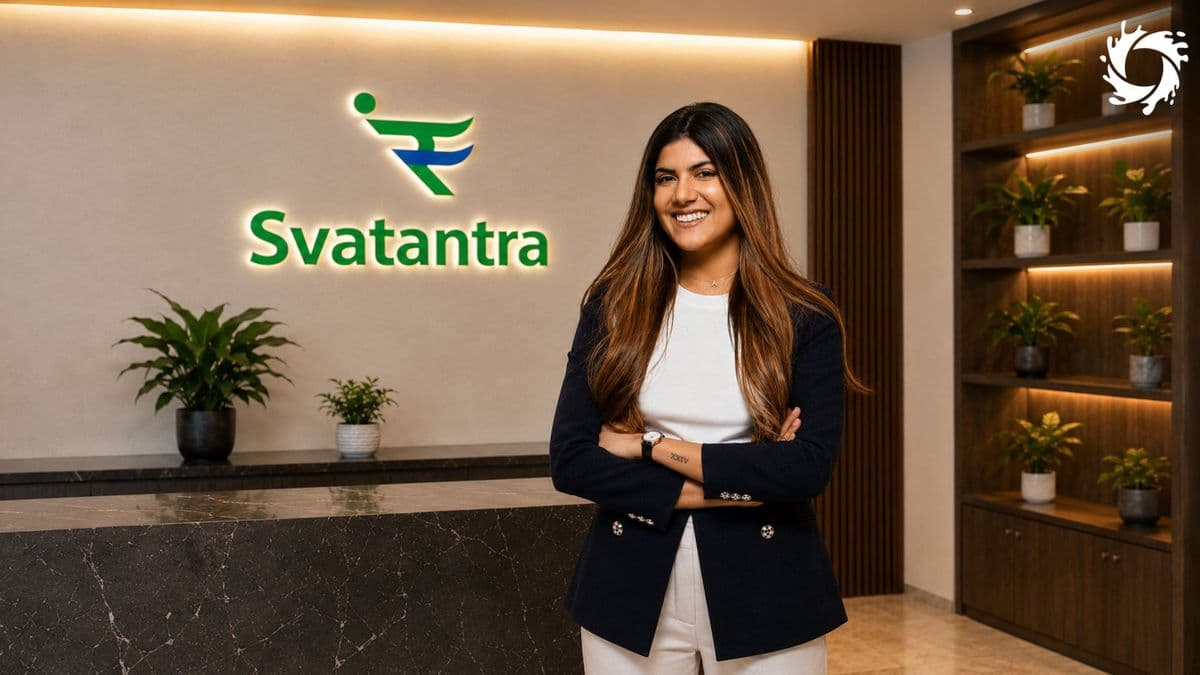
Promoted by Ananya Birla, Svatantra was the first institution to receive the NBFC-MFI licence the RBI introduced in 2011. As of 31 March 2026 it reported consolidated assets under management of ₹23,817.78 crore, serving approximately 4.31 million borrowers through 2,253 branches across 23 states and union territories.
That scale is recent. Svatantra completed its amalgamation with Chaitanya India Fin Credit in March 2026, after acquiring the business from the Navi Group for ₹1,479 crore. The merger made it the second-largest NBFC-MFI in India by microfinance assets.
Ananya Birla and Antimatter Media together hold 59.97% of the company. Violicina holds 28.02% and Multiples Alternate Asset Management 11.45% across three schemes.
The number that defines the risk
Microfinance accounts for 88.56% of Svatantra's AUM.
That concentration is the central fact of this filing. The company also runs affordable housing finance and loans against property through its subsidiary, Svatantra Micro Housing Finance Corporation, but the overwhelming majority of the book remains unsecured group lending to low-income borrowers.
Concentration of exactly this kind is what the RBI has been pushing against elsewhere in the sector. When Ujjivan and Jana Small Finance Banks applied to convert into universal banks, both applications were returned, with high concentration in unsecured microfinance and insufficient loan-book diversification cited as the obstacle. Only AU Small Finance Bank has cleared that bar.
Svatantra is not applying for a banking licence, so that specific test does not apply. But public market investors will price the same underlying question.
Where the money goes
Proceeds from the fresh issue are earmarked for strengthening Tier-I capital and funding future capital requirements, including business expansion and onward lending. The offer for sale gives existing investors, including the private equity holders, a route to partial exit.
Axis Capital, Avendus Capital, IIFL Capital Services, Kotak Mahindra Capital and SBI Capital Markets are the book-running lead managers.