Finsamudra Newsroom, home

Finsamudra Desk

$950 million debt raise funds three renewable energy projects across India

A consortium of domestic and international banks has financed three utility-scale clean energy projects totaling $950 million, marking a major shift in infrastructure financing for round-the-clock renewable capacity.

$950 millionTotal debt financing
Here are the exact details of the transaction and how the capital is being deployed:
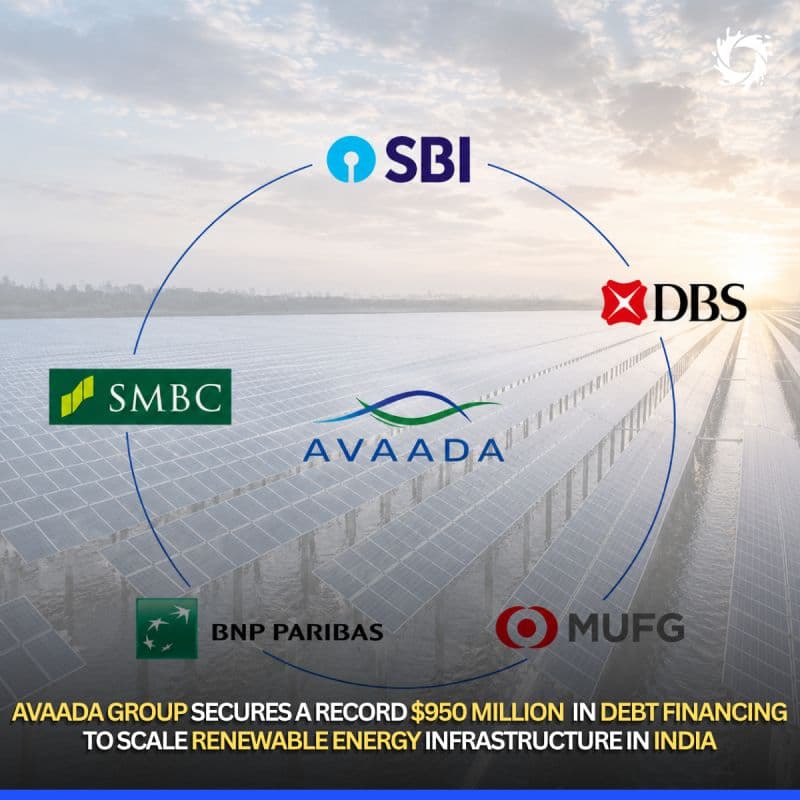
Image: Finsamudra LinkedIn archive
300 MWRajasthan solar capacity (NTPC)
300 MWGujarat solar capacity (SECI)

State Bank of India, Standard Chartered, HSBC, DBS Bank, SMBC Group, MUFG, and BNP Paribas have jointly funded the $950 million debt package. The capital is strictly earmarked for three renewable energy projects currently under construction, with commissioning expected in FY2027–28.

The first project—a Firm and Dispatchable Renewable Energy (FDRE) facility in Bikaner, Rajasthan, backed by SJVN Limited—represents the largest financing transaction in India's FDRE segment to date. FDRE projects deliver round-the-clock clean power, addressing India's baseload energy challenge without fossil fuels.

A 300 MW solar project in Rajasthan, backed by NTPC Green Energy Limited, forms the second deployment. The third is a 300 MW solar project in Gujarat under SECI, the Solar Energy Corporation of India.

The three-project structure reflects a broader banking appetite for India's clean energy infrastructure. Consortiums pooling global and domestic capital signal confidence in long-term renewable generation economics and policy support for decarbonization.

Why it matters

For DSAs and lending partners, this transaction signals institutional comfort with renewable energy project finance at scale. Banks' willingness to commit $950 million across multiple projects validates asset-based lending in the green infrastructure space—a growing segment for NBFC and bank partnerships in India's credit distribution chain.

The deployment model—large-ticket, long-tenor debt for utility infrastructure—contrasts sharply with retail and SME lending. However, it demonstrates how institutional capital flows shape broader financing ecosystems: as top-tier lenders compete in green infrastructure, downstream DSAs and connectors gain operational experience and credit appetite visibility in sustainable sectors.

Sources

Join the conversation on LinkedIn →
Finsamudra DeskNewsroom · 3 Jun 2026, 12:45 pm IST
See all

Get the Morning Brief

India's lending news before your first call — subscribe free

The same daily intelligence 30,000+ CXOs, DSAs and finance professionals follow on LinkedIn, with the Finsamudra take.

The Morning Brief · Free

Get India's lending news before your first call

The daily intelligence 30,000+ finance professionals follow on LinkedIn, in one short email from the Finsamudra Desk.