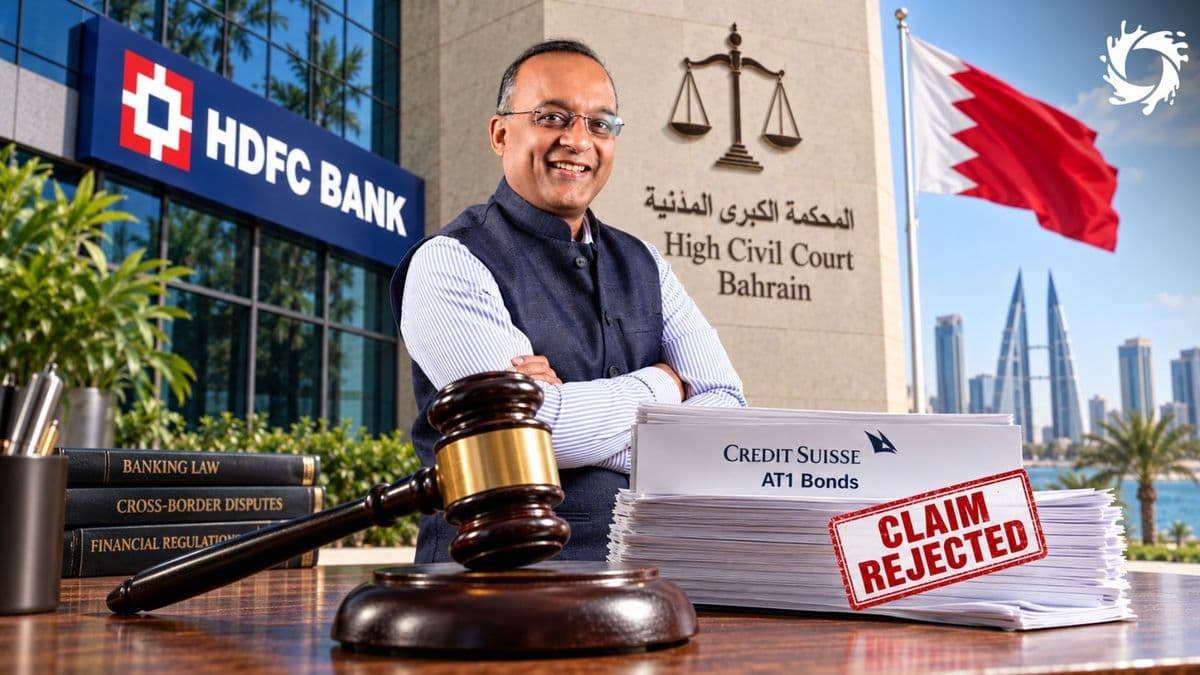
In addition to dismissing the lawsuits, the Bahrain court directed the complaining investors to bear the entire costs of the legal proceedings in all seven cases.
The Fallout from FINMA's $17 Billion Wipeout
The litigation traces back to March 2023, when Swiss financial regulator FINMA orchestrated an emergency rescue merger of Credit Suisse into UBS. As part of the government-brokered rescue, Swiss authorities ordered the complete write-down of $17 billion (CHF 16 billion) of Credit Suisse AT1 contingent convertible debt to zero.
While the equity shareholders received partial compensation via UBS shares, AT1 bondholders were wiped out entirely, sparking unprecedented legal actions across London, Zurich, Singapore, and the Middle East.
Investors who had purchased the AT1 instruments through HDFC Bank’s Bahrain branch subsequently filed lawsuits alleging:
- Gross negligence and intentional misrepresentation
- Incorrect customer risk classification
- Non-disclosure of high-risk write-down features
- Misuse of financial leverage
- Violations of product-suitability guidelines
The Bahrain court dismissed every allegation, concluding that the claimants failed to provide admissible evidence establishing that their financial losses were attributable to any wrongdoing, breach, or misrepresentation by HDFC Bank.
Facilitator vs. Underwriter: A Crucial Distinction
In its legal defense, HDFC Bank drew a clear institutional line between acting as an execution platform and guaranteeing client returns:
"Where required, the Bank will stand with its customers. However, the Bank is not in the business of underwriting the investments made by the customers out of their own judgement and it will therefore defend itself rigorously against any unsubstantiated claims," HDFC Bank stated.
The Bahrain rulings closely parallel a landmark decision by India’s National Consumer Disputes Redressal Commission (NCDRC) in March 2026. The NCDRC similarly dismissed investor claims against HDFC Bank, noting that:
- The bank functioned purely as an execution facilitator.
- High-net-worth investors enjoyed full autonomy in decision-making.
- Complaints of "mis-selling" emerged solely as an afterthought once the securities defaulted.