FinsamudraNewsroom

Finsamudra Desk

HDFC Bank governance row escalates as ex-chairman rejects external review findings

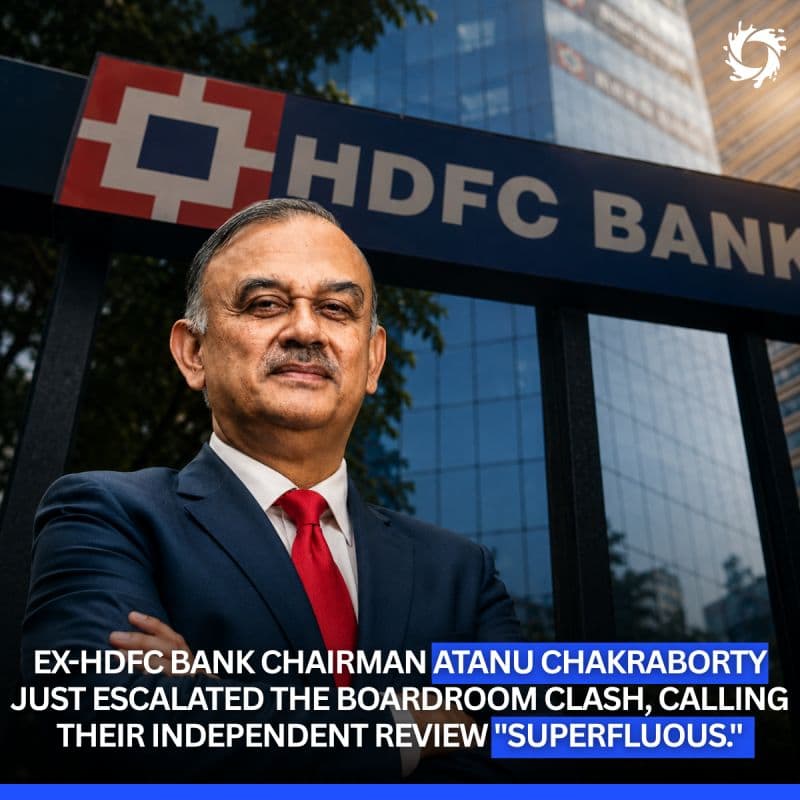
Former Chairman Atanu Chakraborty has publicly challenged the independence of HDFC Bank's ₹-backed legal investigation, refusing to participate and dismissing its findings as conclusions reached without his input.

Three monthsInvestigation duration
Boardroom battles in Indian banking are incredibly rare. Public boardroom battles at India's largest private bank are virtually unheard of.
Image: Finsamudra LinkedIn archive
Zero recordedEvidence found to support Chakraborty's claims
Two major firmsLaw firms engaged

HDFC Bank's board commissioned an external legal review by two major law firms to investigate ethical concerns raised by former Chairman Atanu Chakraborty upon his resignation. After three months of document review, the firms concluded there was zero recorded evidence to support his claims.

Chakraborty has now publicly rejected the entire investigation, calling it "superfluous." His objection hinges on a procedural issue: he refused to participate because the bank repeatedly declined to provide him with the official terms of reference—the document that defines what investigators can and cannot examine.

In corporate governance, terms of reference are critical. They establish the scope and boundaries of an investigation, determining which areas fall under scrutiny and which remain off-limits. Without seeing these terms, Chakraborty argues he could not assess the investigation's fairness or participate meaningfully.

This public dispute between a former chairman and an incumbent board represents rare transparency into internal governance tensions at India's largest private bank. The back-and-forth raises a systemic question: when a bank hires external law firms to investigate itself, how independent can the findings be if the board controls what the investigators are permitted to examine?

The row highlights a structural tension in Indian corporate governance. External reviews are meant to lend credibility to internal investigations, yet their scope is set by the very institution being reviewed. This creates an inherent conflict of interest that questions whether such investigations serve as genuine audits or as tools to legitimize board decisions.

Why it matters

For DSAs, connectors, and lenders working with HDFC Bank, governance clarity directly affects partnership stability and operational risk. Public disputes at the board level can signal deeper institutional tensions and raise questions about decision-making processes, compliance cultures, and the bank's appetite for managing dissent. Lenders and connectors rely on banking partners to operate with transparent governance; boardroom chaos—especially when unresolved—introduces uncertainty into credit distribution partnerships.

The broader implication affects how India's banking and NBFC ecosystem views external oversight mechanisms. If major institutions can commission investigations with self-defined scope and then declare them conclusive, it weakens confidence in corporate accountability. For DSAs distributing loans through banks and NBFCs, this governance gray area underscores the importance of understanding your partners' internal checks and balances before deepening credit distribution relationships.

More on HDFC Bank

Every story on HDFC Bank →

Sources

Join the conversation on LinkedIn →
Finsamudra DeskNewsroom · 28 Jun 2026, 10:45 am IST

Refer loans to banks and NBFCs? Become a loan DSA partner

See all

Finsamudra Desk

The 40-Year Anchor: Why HDFC Bank’s Board Extended Executive Director V. S. Rangan’s Mandate by One Year

In a regulatory disclosure filed on Friday with the BSE and NSE, HDFC Bank Limited announced that its Board of Directors—acting upon the recommendation of the Governance, Nomination & Remuneration Committee—has approved the re-appointment of V. Srinivasa Rangan as a Whole-time Director (designated as Executive Director) for a period of one year, effective November 23, 2026 through November 22, 2027.

Banking2 min read

Finsamudra Desk

From Pre-Liberalization 1988 to a ₹98,000-Crore Mortgage Giant: Inside PNB Housing Finance’s 38-Year Transformation

On November 11, 2026, PNB Housing Finance Limited (NSE: PNBHOUSING • BSE: 540173) completed 38 years of corporate operations. Incorporated in 1988 as a specialized mortgage subsidiary of Punjab National Bank (PNB)—predating India’s 1991 economic liberalization—the institution has transformed alongside the country's demographic and financial evolution.

Banking2 min read

Finsamudra Desk

The Governance Architect: Inside IndoStar Capital Finance’s Appointment of Reshma Ramchandani as Company Secretary

In compliance with Regulation 30 of the SEBI (Listing Obligations and Disclosure Requirements) Regulations, 2015, systemic non-banking financial company IndoStar Capital Finance Limited (NSE: INDOSTAR • BSE: 541336) has announced the appointment of Ms. Reshma Ramchandani as its new Company Secretary and Compliance Officer, designated as a Key Managerial Personnel (KMP) with effect from October 30, 2026.

Banking3 min read

Get the Morning Brief

India's banking and finance news before your first call — subscribe free

The same daily intelligence 41,000+ CXOs, DSAs and finance professionals follow on LinkedIn, with the Finsamudra take.

The Morning Brief · Free

Get India's banking and finance news before your first call

The daily intelligence 41,000+ finance professionals follow on LinkedIn, in one short email from the Finsamudra Desk.